
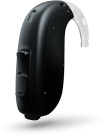
HOW HEARING AIDS WORK
One small device. Three precise jobs.
A hearing aid first captures sound, then processes it according to the wearer’s hearing profile, and finally delivers the processed sound toward the inner ear.
The source guide explains that a microphone captures incoming sound and converts it into an electrical signal or numerical code. The hearing aid then processes that information using customized settings based on the person’s hearing loss, preferences, and needs.
The processed signal is converted back into sound and sent toward the inner ear so the auditory nerve can carry the information to the brain.

THE SIGNAL JOURNEY
From the room around you to the auditory nerve.
Each step happens quickly, but the processing inside the device is what allows sound to be shaped for an individual hearing profile.
Capture
The microphone picks up sound and converts it into an electrical signal or numerical code.
Calculate
Customized processing adjusts the incoming signal based on hearing loss, preferences, and listening needs.
Deliver
The processed signal becomes sound again and is delivered toward the inner ear, where the auditory nerve carries it to the brain.
THE SIGNAL JOURNEY
From the room around you to the auditory nerve.
Each step happens quickly, but the processing inside the device is what allows sound to be shaped for an individual hearing profile.

ANALOG HEARING AIDS
Straightforward amplification.
Analog hearing aids convert sound waves into electrical signals. Those signals are amplified and then sent toward the auditory nerve. Analog hearing aids still require programming by a hearing-care provider.
Advantages
- Generally less expensive than digital hearing aids.
Disadvantages
- Fewer settings than digital hearing aids.
- Less personalization.
- Fewer options to choose from.
DIGITAL HEARING AIDS
More precise, flexible processing.
Digital hearing aids convert sound into numerical codes and use algorithms to personalize the listening experience. Like analog devices, they require programming by a hearing-care provider.
Advantages
- More sensitive programming for greater customization.
- Many more options available.
- Greater control over amplification.
- Pitch and frequency can be increased or decreased.
Disadvantages
- Advanced digital models can have a higher price point, though baseline digital options may be more affordable.
READY TO FIND THE RIGHT HEARING AID?
Choose technology around your hearing and your life.
Summerlin
1401 Hillshire Dr Suite 130, Las Vegas, NV 89134
Henderson
2821 W Horizon Ridge Pkwy Ste. 221, Henderson, NV 89052