
You do not have to simply wait for tinnitus to go away.
Here at Hearing Associates of Las Vegas, our hearing specialists provide a variety of tinnitus management tools such as tinnitus tips which can improve your quality of life.
To help you manage your tinnitus on a day-to-day basis, try these 12 tinnitus management tips.

Four areas you can influence every day.
Sound exposure
Protect your hearing and avoid total silence.
Body & sleep
Support circulation, exercise, and consistent rest.
Stress & coping
Use relaxation techniques and social support.
Professional guidance
Learn more and be evaluated by a hearing expert.
Practical ideas you can use day to day.
These are practical steps you can try between visits. They do not replace an evaluation.

Reduce exposure to extremely loud noises
Tinnitus is often triggered by exposure to loud noises. These triggering instances can lead to a temporary increase in your tinnitus symptoms. To prevent this, use hearing protection when you know you will be exposed to loud noises such as concerts, shooting ranges, power tool use, and other instances.
Avoid over-consumption of stimulants
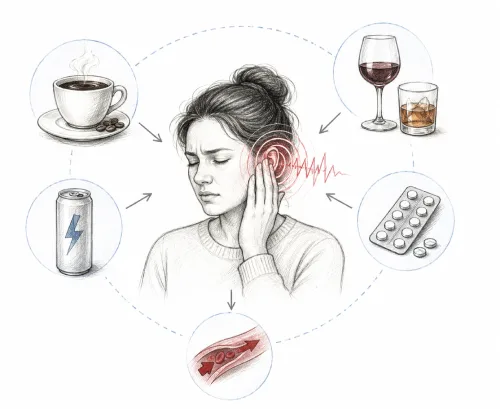
Consuming stimulants like caffeine can cause your tinnitus to become worse. Stimulants change blood flow, and that can impact your tinnitus. While you don’t have to cut stimulants out completely, monitor your intake and keep track of what level of stimulants does trigger an increase of tinnitus symptoms.

Decrease your salt intake
Excess salt can impact your blood pressure, which in turn can impact your tinnitus. By reducing your salt intake, you may be able to alleviate the intensity of your tinnitus.

Avoid being in total silence
When there is nothing else to hear, your perception of your tinnitus can increase significantly. Try using sound generators that produce soothing background sounds to keep your tinnitus negligible.

Keep track if there are common triggers
By doing a bit of detective work, you can figure out what normally triggers your tinnitus. Once you know what causes it to become worse, you can avoid these triggers or plan for a tinnitus flare-up.

Monitor your blood pressure
As you can see from some of our earlier tips, blood flow and blood pressure play an important role in triggering your tinnitus. By ensuring your blood pressure remains in a healthy range, you can alleviate several tinnitus triggers.

Reduce fatigue
Sleep deficiency and over-exhaustion in general is a common trigger for tinnitus. Adults require at least 7 hours of sleep every night, and it is best if you commit to a regular sleep schedule.
Cut out nicotine consumption
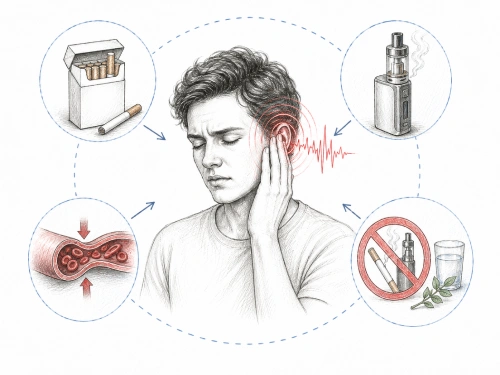
Nicotine in cigarettes and some vape liquids can restrict blood flow and act as a stimulant, which can make tinnitus more noticeable. Cutting out nicotine may change how strong the sound feels.

Practice relaxation techniques
Reducing stress is a vital part of managing tinnitus. Try to implement simple daily relaxation techniques such as yoga, meditation, and other stress level lowering activities.

Join in support groups
Tinnitus has a significant emotional impact as well as a physical one. By joining a support group, you can receive emotional support and potentially targeted tinnitus advice. If there are no support groups near you, there are active tinnitus forums you can post to online and receive help.

Educate yourself about tinnitus
Learning more about your condition is an essential part of managing your tinnitus. As tinnitus can only be perceived by the individual who struggles with tinnitus, dealing with tinnitus can be isolating. By educating yourself on tinnitus, Learning more about tinnitus is part of managing it. Because only you can hear it, it can feel isolating. Learning what it is can help you see that the sound is real and that it can be addressed. and can be addressed.

Be evaluated by a hearing expert
Last but certainly not least, you should be evaluated by a hearing expert if you struggle with tinnitus. There is often a connection to hearing loss which can be corrected with hearing aids. Also, there are a variety of other tinnitus management devices which our hearing instrument specialist can help you determine if it will help you.
Turn the volume down before playing tinnitus samples.
These are some of the most common tinnitus sounds. If your tinnitus sound is not on the list, pick the one which is closest to help your loved ones understand.
Be absolutely sure to not use earbuds or headphones while listening and turn the volume down on your device before playing the clips. Much like living with tinnitus, these clips are piercing and can be painful.
Our hearing instrument specialists at Hearing Associates of Las Vegas are well-informed when it comes to tinnitus education, current research, and treatment methods.
Safer listening: use your device speaker at a low volume rather than headphones or earbuds.

Help friends and family hear something closer to your experience.
One of the major frustrations for those who suffer from tinnitus is the inability to describe to others what they are dealing with. Ask a friend or family member to listen to the tinnitus sound examples on our tinnitus page. Pick the clip closest to what you hear. It will not be exact, but it can help them understand why the sound is so hard to ignore.
Listen to tinnitus sounds - Choose the sound that is closest to your own tinnitus so loved ones can better understand it.
Talk with a tinnitus expert - Discuss education, current research, treatment methods, and symptom management.
Need more than general tinnitus tips?
Summerlin
1401 Hillshire Dr Suite 130, Las Vegas, NV 89134
Henderson
2821 W Horizon Ridge Pkwy Ste. 221, Henderson, NV 89052