
Objective verification replaces guesswork.
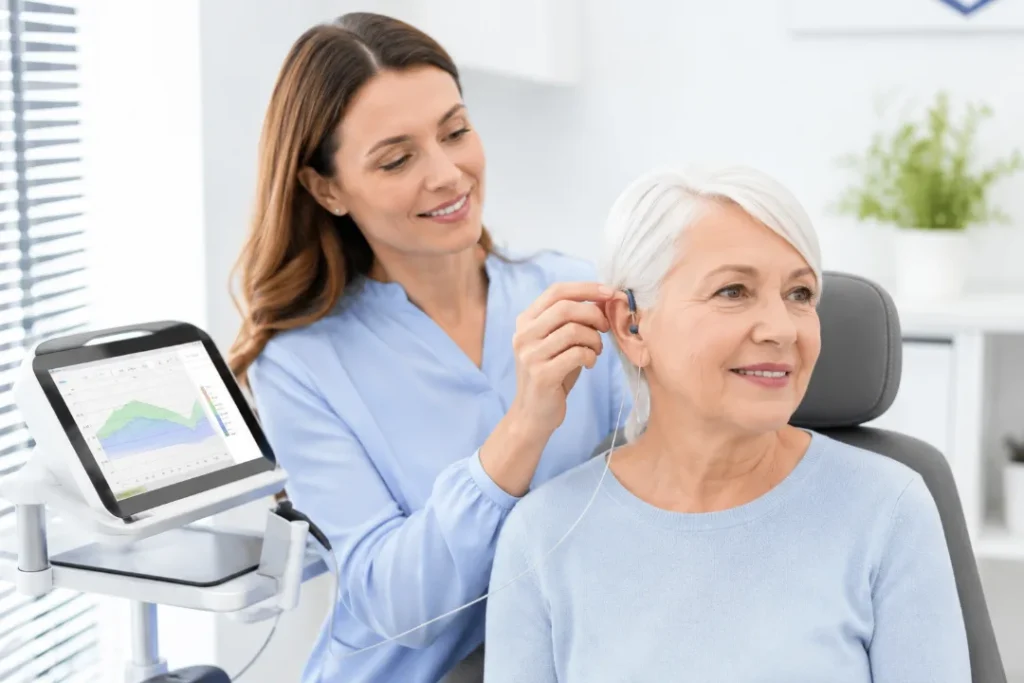
Real-ear measurements are an important part of hearing aid fitting because they measure the actual sound level produced inside your ear canal and compare it with the amplification prescribed for your hearing loss.
This helps the hearing professional verify that sound is neither under-amplified nor over-amplified and allows programming changes to be made with objective data rather than relying on assumptions alone.
At Hearing Associates of Las Vegas, real-ear measurements are part of the fitting process every time.
Focus on speech
Verification centers on making human speech more audible and understandable.
Include family
You and the people close to you can participate in the fitting.
Immediate results
Adjustments can be measured and demonstrated during the fitting.
Accurate programming
Measured ear-canal output gives a clearer basis for fine-tuning.
More confidence
Visible improvement makes the fitting process easier to understand.
Hearing aids need a prescription-like fit.
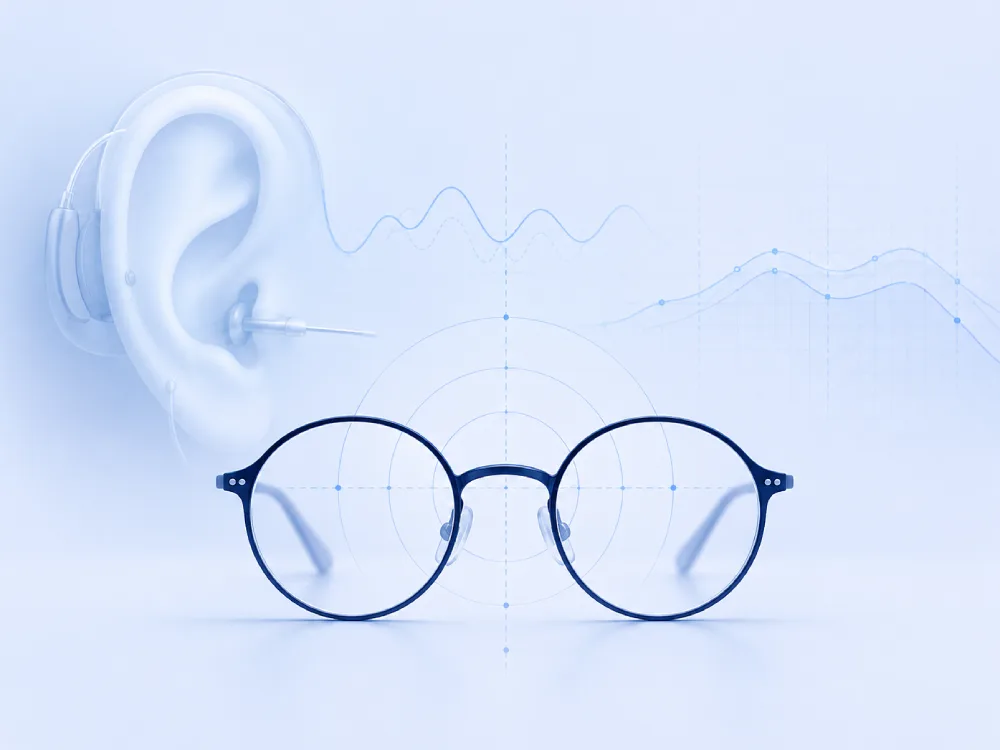
Choosing hearing aids without verifying their output would be similar to choosing eyeglasses until the view simply looked less blurry. A vision prescription is matched to an individual eye; hearing-aid amplification should likewise be verified against individual hearing needs.
The fitting target describes how much amplification is needed at different frequencies so important sounds are audible while remaining comfortable.
Verification matters because every ear is acoustically different.
The shape of the ear canal, the hearing loss, the hearing aid, and the chosen coupling can all influence the sound that actually reaches the eardrum.
Measure. Compare. Adjust. Verify again.
Real-ear measurement is genuinely sequential, so the fitting process is shown as a simple four-stage path.
The goal is useful speech intelligibility while keeping amplified sound appropriate and comfortable for the individual wearer.
Place the probe tube
A small probe microphone tube is positioned in the ear canal so sound can be measured close to the eardrum.
Present a calibrated signal
A speaker in front of the patient plays a known calibrated sound while the hearing aid is in place.
Compare response with target
The measurement is sent to fitting software so the hearing professional can see how closely output matches the prescribed amplification.
Adjust and remeasure
Programming is changed as needed, then measured again until the fitting is as close as practical to the desired target.
A measured target is not the same as personal comfort.
Use speech itself to help verify the fitting.
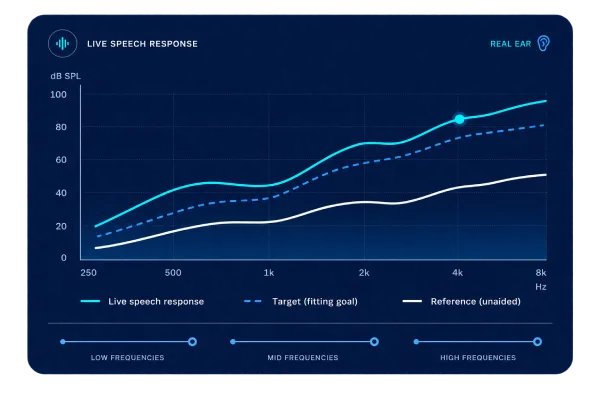
Live speech mapping is a real-ear verification method that uses speech as the test signal. Small microphones in the ear canal measure the hearing aid response while the patient listens, giving the hearing professional a visual representation of how amplified speech is reaching the ear.
The method accounts for the individual acoustics of the ear and the individual hearing loss rather than assuming one generic response for everyone.
Bring a familiar voice.
A family member or close friend can participate so the fitting includes speech the patient recognizes from everyday life.
Use speech itself to help verify the fitting.
Specialized equipment lets the hearing professional view measured hearing-aid output against fitting targets on screen.
The fitting becomes something you can see and hear.
Instead of adjusting a hearing aid only from generic settings or patient description, live speech mapping lets the patient, hearing professional, and family see how changes affect measured speech audibility during the appointment.
Watch the response
The equipment displays what is happening through the hearing aids in real time.
Listen to each adjustment
Programming changes can be heard immediately while the measured response is visible.
Make it a group effort
Family participation helps everyone understand the impact of hearing loss and better programming.
More evidence. More participation. More confidence.
Hearing aids may need periodic adjustment as hearing and listening needs change. Live speech mapping makes those visits more informative because programming changes can be verified, demonstrated, and discussed rather than judged only by memory or guesswork.
Prioritizes human speech - Programming is connected to the sound people most need to understand every day.
Supports successful fittings - Objective verification increases the chance that output is closer to the intended prescription.
Shows tangible improvement - Visual measurements help patients understand whether a programming change improves audibility.
Includes loved ones - Family members can better understand how hearing loss affects daily life.
Want your hearing aid fitting verified with real-ear measurements?
Summerlin
1401 Hillshire Dr Suite 130, Las Vegas, NV 89134
Henderson
2821 W Horizon Ridge Pkwy Ste. 221, Henderson, NV 89052